


Mu-Tron Bi-Phase
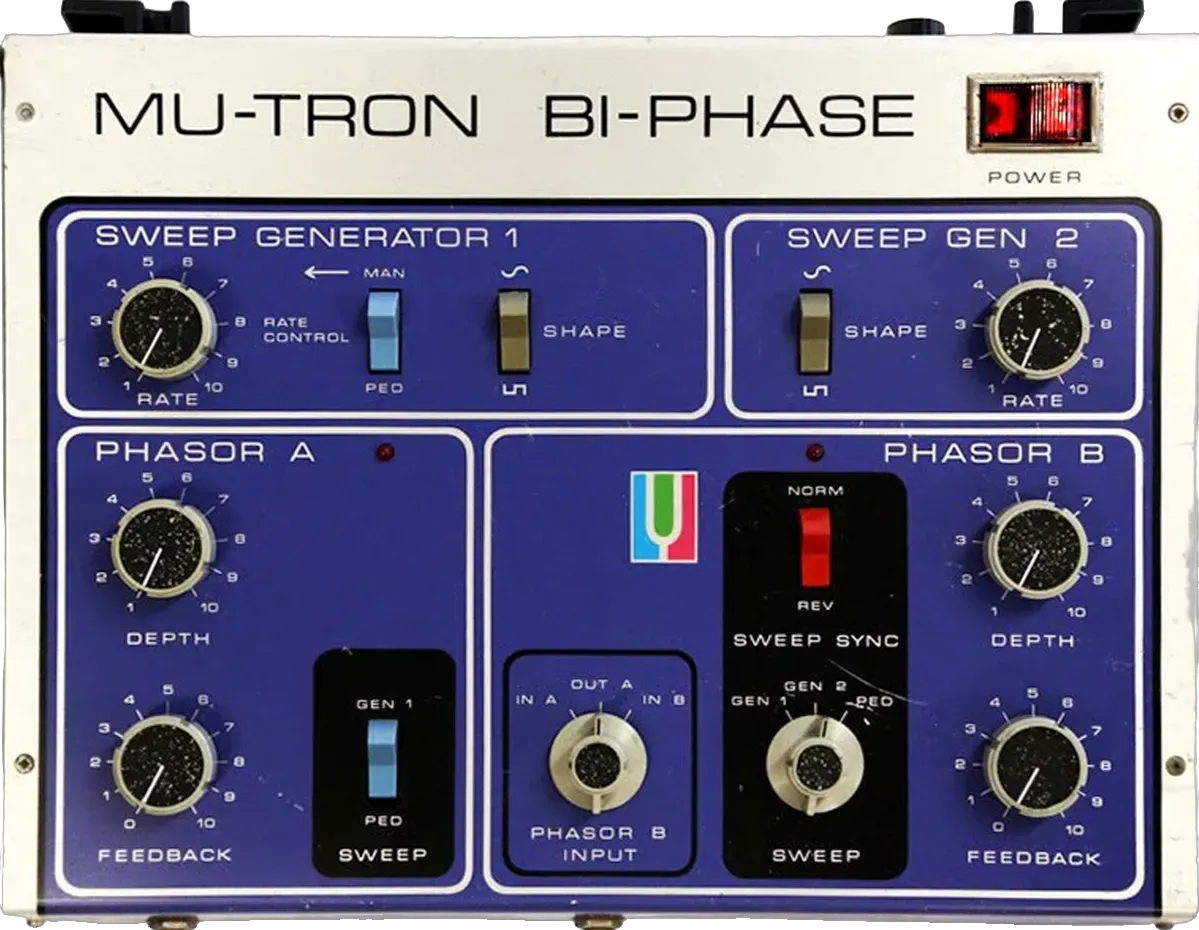
PHASER
Description
- Used by guitar player PRINCE in his first records.
The Mu-Tron Bi-Phase is a effects pedal used by Prince on records "For You", "Prince" and "Dirty Mind". It can be heard on the songs “In Love”, “Soft and Wet”, “Just As Long As We're Together”, “So Blue”, “I Wanna Be Your Lover” “Do It All Night” and “Head” and was used as a guitar and keyboard effect. Prince used a Mu-Tron Bi-Phase phaser pedal on the Prince tour.
By the mid 1990s it was still in his collection at Paisley Park at his house« and studio.
-
“The World’s First Dual Phasor
The Mu-Tron Bi-Phase consists of two independent 6-stage phasor circuits, two sweep generators (oscillators), and a number of unique additional controls to allow maximum flexibility in generating a variety of phasing effects. The Mu-Tron Bi-Phase also offers several convenience features including LED indicators on each phasor, mike stand socket on bottom of housing for above-the-floor mounting, and AC cord storage on back panel. The unit is furnished with a dual foot switch and has an optical photoelectric foot pedal and provision for synthesizer interface for external control of sweep. And, like all Mu-Tron products, the Mu-Tron Bi-Phase and its accessories are solidly constructed to withstand the most severe professional use.”– From original Musitronics Bi-Phase ad circa 1970s
-
Controls:
Sweep Generator 1
Rate controls the speed/rate of the LFO wave that controls the effect.
Man/Ped switches the rate of the LFO between the setting of the Rate knob and the pedal.
Shape switches the LFO between a square and a sine wave.
Sweep Generator 2
Rate controls the speed/rate of the LFO wave that controls the effect
Shape switches the LFO between a square and a sine wave.
Phasor A
Depth controls the depth/amplitude of the modulation (the size of the range in which the effect sweeps)
Feedback sets the amount of effected signal fed back into the effect (for a stronger effect)
Sweep (Ped/Gen 1) switches the sweep control of the phasor between pedal control and LFO control by Sweep Generator 1
Phasor B
Depth controls the depth/amplitude of the modulation (the size of the range in which the effect sweeps)
Feedback sets the amount of effected signal fed back into the effect (for a stronger effect)
Sweep Sync (Norm/Rev)switches between normal sweep and reverse sweep (if you use the same sweep source as phasor A, phasor B will move in the opposite direction)
Sweep (Gen 1/Gen 2/Ped) switches the sweep control of the phasor between pedal control, LFO control by Sweep Generator 1 and LFO control by Sweep Generator 2
Phasor B Input selects a source for Phasor B: input A (same input as Phasor A), output A (Phasor B gets the output of Phasor A as input), input B (separate input for Phasor B)
-
Specifications:
Input Impedance: 300k ohms minimum, unbalanced
Output Impedance: 600 ohms, unbalanced
Insertion Loss: Less than 1db
Frequency Response (Bypass): 20Hz – 20kHz ± 2db
Signal Handling Capability:
Each Phasor, no feedback, 4V RMS minimum.
Both Phasors (in series), 50% feedback, 2V RMS minimum.
Both Phasors (in series), 100% feedback, 1V RMS minimum
Phasing Rate: Sweep Generators .1Hz-18Hz
AC Power Requirements: 115V AC, 60Hz, 15 watts
Dimensions: 13¾” w. X 10¾” d. X 4¼” h.
Weight (less footswitch and foot pedal): 7¾ pounds
Media
Videos
Demo by hiwattbob (EN)
Demo by Reverb (EN)
Demo by Joe at Reverb
Manuals

Technical data
Width
000.00 mm
Depth
000.00 mm
Height
000.00 mm
Weight
000.00 mm
Circuit type
analog
Voltage
115V DC, center negative